Young Conservationists
  • Home
  • About
  • Project Ideas
    • Submissions
  • Blog
  • Photo Album
  • Links
    • Wildlife Rehabilitators
    • Volunteer Opportunities
    • Young Birders Clubs
    • Other

Pine Siskin

2/28/2016

 
Picture
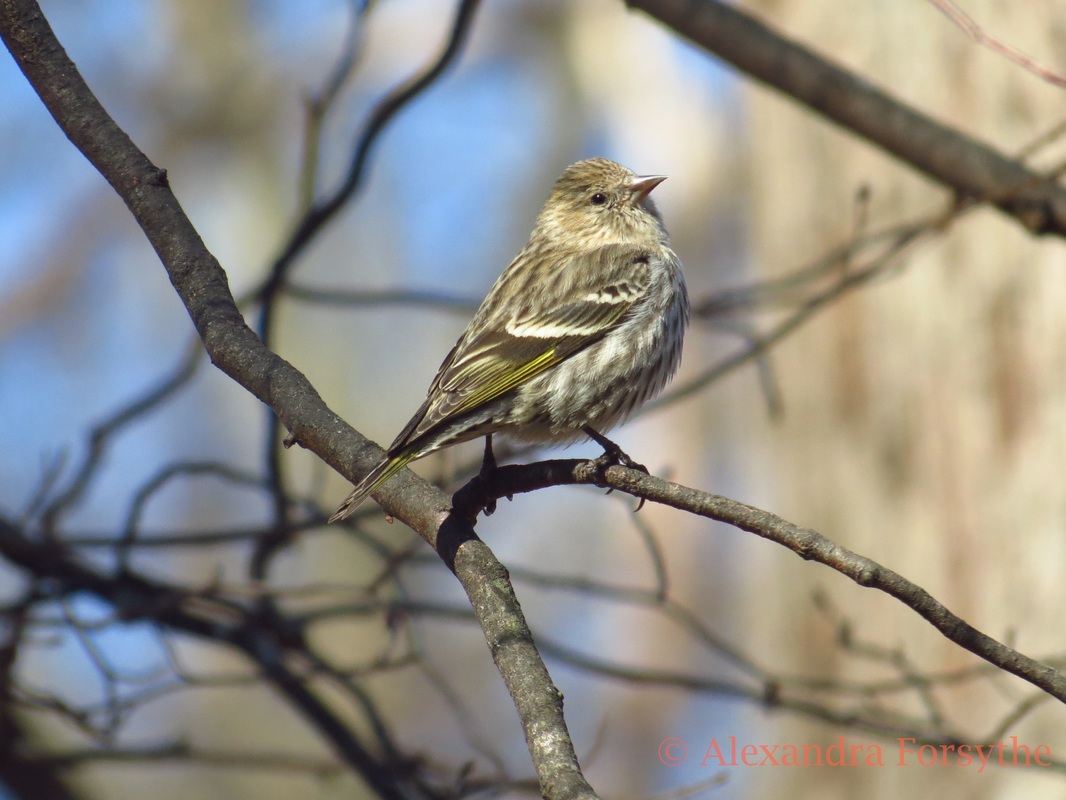
This finch dressed like a sparrow can be seen in abundance one year, then rarely the next. The migration patterns are variable. During irruption years Pine Siskins travel further south and east in the winter in search of food. Normally seen in the northern states, some irruption years have resulted in large flocks of Siskins in places as far south as Louisiana, Alabama and Florida. In the winter of 2007-8 there were Pine Siskins reported at only 24% of the Project FeederWatch Sites. The following year was an irruption year, with 50% of the Project FeederWatch sites reporting flocks of Pine Siskins. Their movements are variable, with some migrating from northeast to northwest, while others migrate from north to south. A Siskin banded in Pennsylvania was later recaptured in Washington, while another bird banded in Texas was recaptured in Minnesota. They migrate in flocks of a half dozen to hundreds, often stopping at nyjer feeders along the way to dine alongside goldfinches. 

They consume a variety of insect and weed pests, including aphids, scale insects, and thistle. As the flock forages through the trees, parts of the flock "leapfrog" over one another. "Often when feeding, there are no birds in flight; at other times part of the flock may take wing and pass over those still feeding to other food trees. As the birds thus go "leapfrogging", the entire mass of the flock of busy, lisping birds appears to flow through the forest. Then all of a sudden the lisping ceases and the flock is silent; it takes flight with a very audible whirring of wings and flies rapidly away" - A. C. Bent, "Life Histories of Familiar North American Birds".

The courtship is a sweet combination of a song and a dance on the wing. Louise de Kiriline Lawrence, naturalist and frequent contributor to National Audubon Society's magazine "Audubon", described the courtship beautifully: "With a beam of sunshine illuminating his golden flashes, the male rose into the air with tail spread wide and wings in a blur of rapid motion. To the accompaniment of a flight song which seemed to express far more musical adoration than could be contained in so small a body, he described circle after circle around his chosen mate. That the female reflected none of her partner's emotion in no way seemed to dampen his ardor and, after he dropped on to a twig from pure exhaustion to catch his breath, a few moments later he rose again in a repeat performance no less ecstatic than the first... In the midst of all this sweet singing, two birds swing into the air in an extensive 'cloud chase,' their movements tightly synchronized as they alternate in the roles of pursuer and pursued... The female sat on a twig. Presently the male alighted on the same twig, hopped up to her and offered her a small particle, of what I could not see. She crouched and, with trembling wings, accepted the offering."

Siskins are often thought to be rather tame. E. R. Davis studied the Siskins in 1926 and wrote: "In a short time the birds came to regard me as their friend, and in the days that followed grew to be exceedingly sociable and to lose every vestige of fear. Whenever I would appear at the window, or step outside the door, down they would come and, settling upon my head, shoulders, and arms, would peer anxiously about for the food that they had learned to know I held concealed from them in a box, dish, or other receptacle."


Pine Siskins may be tame, but they are also tough. They can withstand temperatures down to -94˚ (that's 94 degrees below zero!) by increasing their metabolic rate up to five times their normal rate for several hours! They also put on large fat deposits to help insulate themselves, and they store 10% of their body weight in seeds inside their crop to sustain them for up to 6 hours in subzero nighttime temperatures.
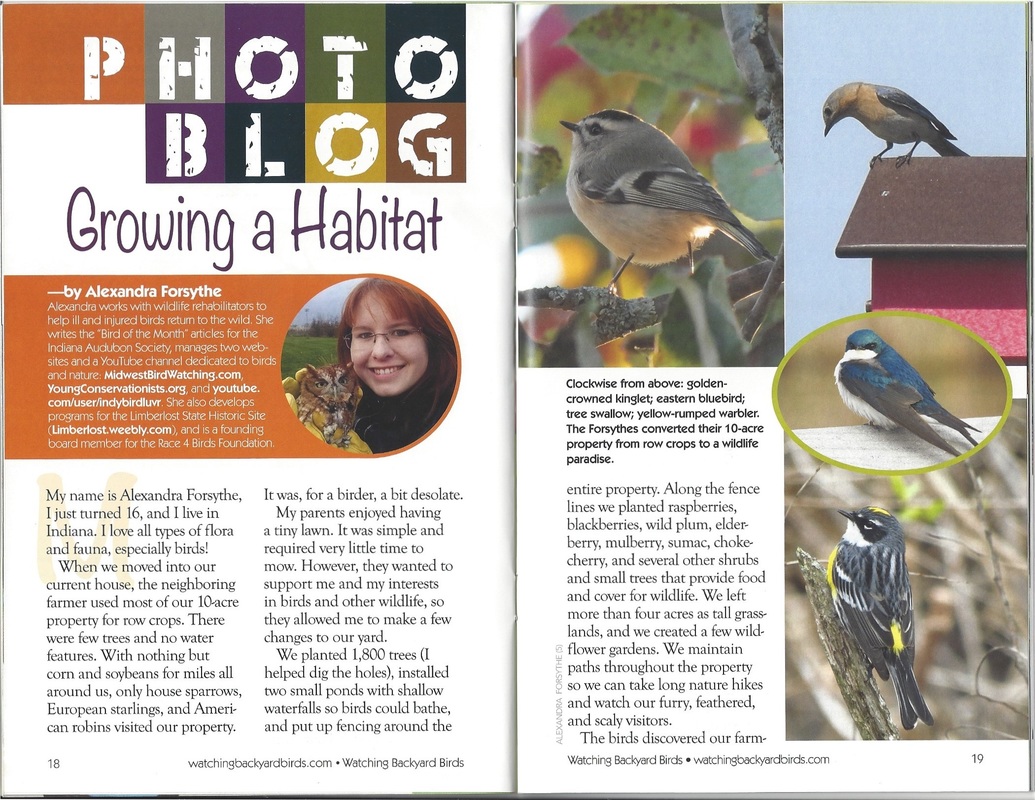
Creating a Backyard Habitat

10/14/2015

 
Picture
Picture
Picture
Picture

Peregrine Falcon

6/1/2015

 
Picture
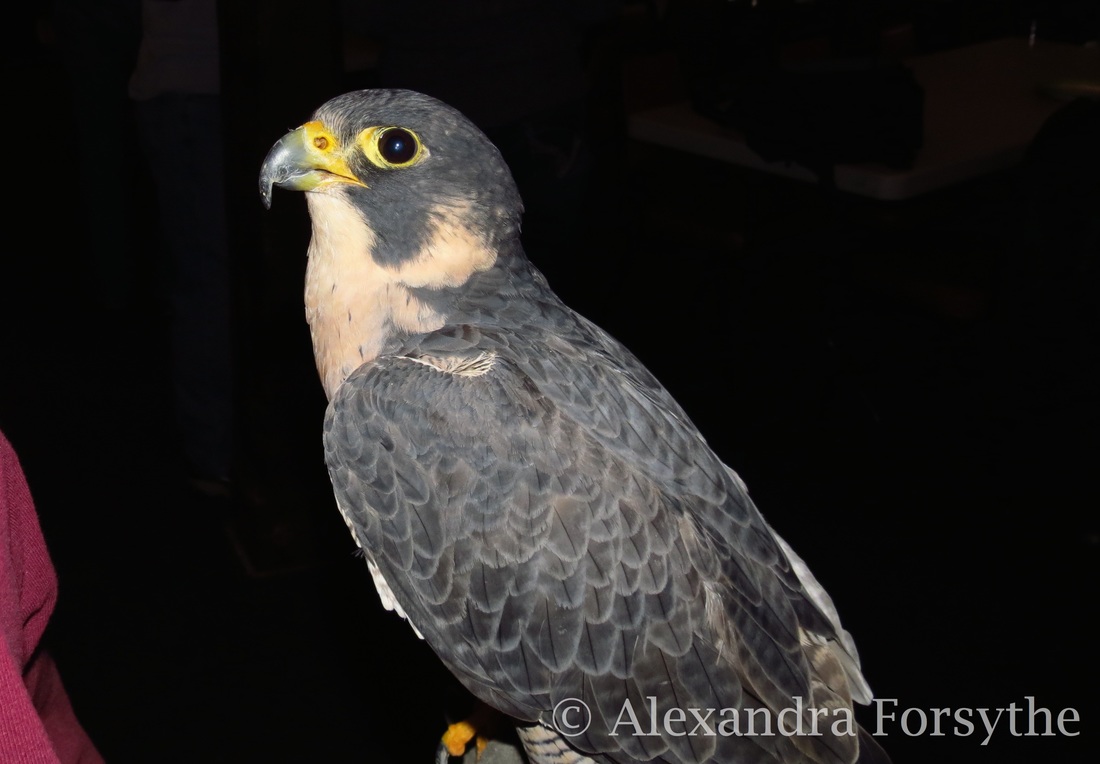
The Peregrine Falcon is the fastest animal in the world, capable of traveling up to 200 mph in a “stoop” or dive. Their primary food source is birds, and they have been documented preying on over 450 species of birds in North America, including Sandhill Cranes, White-throated Swifts and hummingbirds. As fast as Peregrines are, however, they could not escape the deadly impact of humans.

Like the Bald Eagle, the Peregrine Falcon was dramatically affected by the pesticide DDT. By 1965 no Peregrines were known to be nesting east of the Mississippi, and less than 40 pairs were nesting west of the Mississippi by 1975.

Unwilling to sit idly by and watch these magnificent birds of prey go extinct in the U.S., Dr. Tom Cade created the Peregrine Fund, a captive breeding program to reintroduce Peregrines. Getting the Peregrine Fund started was not easy!

I had the honor of interviewing Mr. Cade about his work with the Peregrine Fund. This is what he had to say about the early days of the Fund: 

“The main problem was to find the money necessary to do the captive breeding and the release of falcons back into outdoor environments. In 1967 I joined the faculty of Cornell University as a professor of zoology. One of the conditions of my hiring was that the university would build a breeding facility for falcons. It took the university four years to find the money to build the facility for $150,000, but we finally got started in December of 1970. Being an academic scientist all of my experience in raising money for research had relied on obtaining grants from organizations such as the National Science Foundation, Office of Naval Research, and the National Institutes for Health, and I thought I could support the falcon program that way. It never occurred to me in the beginning that I would need to establish a nonprofit organization called The Peregrine Fund. For the first four years I did receive support from NSF, but it was little more than enough to provide salaries for a couple of assistants, and it became clear that what we were trying to accomplish was too applied to attract much support from the scientific community. Then the Laboratory of Ornithology, with which the falcon program and facility were associated at Cornell, began receiving unsolicited contributions from the general public to support the falcon work. That gave me the idea to seek this source of funding actively, and I went to the university’s Development Office for advice and help. They agreed to help but advised that I would have to abide by their priorities for asking major donors for support. To make a long story short, the arrangement never worked, because every time I wanted to approach a potential donor, the Development Office had a higher priority for that person. One of the private breeders who cooperated with me in keeping and breeding birds of prey suggested that we form our own nonprofit corporation independent of the university to support our mutual interests in breeding and releasing Peregrine Falcons; that was done in 1975. Soon we were receiving funds from various conservation organizations, foundations, many private donors, and both federal and state agencies involved in endangered species work. It turned out to be the smartest thing I ever did, but I can’t claim much credit for dreaming it up. Plato, or someone back in his time, said that ‘Necessity is the mother of invention.’”  

Needless to say, the Peregrine Fund was a huge success and serves as a model of conservation. Thanks to the Fund’s efforts, by 1999 there were over 1650 breeding pairs in the U.S. and the Peregrine was removed from the endangered species list. Mr. Cade was present at the bittersweet moment when his first brood of fledglings that were hatched in the wild flew away. I asked him what he felt at that moment. He said, “This was a great time in the peregrine recovery program. I will never forget climbing up into the nest tower at Brigantine National Wildlife Refuge near Atlantic City with my colleague, Jim weaver, and banding the four nestlings. Looking out over the expanse of the Brigantine marshes, I realized that we had surmounted the last hurdle...”

He also informed me of some interesting survival rate differences based on nesting sites. “At first when falcons started nesting on buildings, and particularly on bridges, it appeared that fledging success was quite a bit less than for young fledged from cliffs.  On bridges quite a few young fell into the water below when they first tried to fly and drowned, but some made it out of the water.  But the Peregrines have persisted in moving into urban and industrial landscapes to nest on manmade structures in a spectacular way, so that the fatalities may simply look worse than they really are in terms of population maintenance and growth.”

During his work, Mr. Cade noticed an oddity that remains a mystery. “Falcons that breed successfully in captivity lay eggs that average smaller than the eggs collected from wild birds. However, this is not an inherited trait, as the young birds that are released into the wild and become breeders lay eggs of normal size.  Something about captivity reduces egg size, but we do not know what it is.”

The Peregrine Fund has expanded their focus beyond that of the Peregrine Falcon. 

“The Peregrine Fund now works on a worldwide scale on many kinds of projects to do with birds of prey, so naturally there are many projects I would like to see done.” One goal is to have at least one trained raptor biologist in every country to monitor populations. Another project is the California Condor. “We have been trying to reintroduce captive-bred condors into northern Arizona and southern Utah for the past 15 years but are unable to establish a self-sustaining population because of lead poisoning from bullet fragments and bird shot in the carcasses they eat. It is easy to breed condors in captivity, relatively easy to get them re-established as independent, free-flying birds in the wild, but no condors have survived long enough to produce more than one or two young before they die of lead poisoning. We desperately need some kind of a national PR campaign to convince the shooting public to stop using lead bullets and lead shot in their ammunition. Ideally this problem should be taken care of by state and federal regulations, but political idealism is hard to come by these days.” 

His advice to anyone interested in starting up a conservation program: “Start small with a well defined goal that you are totally committed to, and come hell or high water you will succeed.”

The Inaugural Indiana Dunes Birding Festival

5/14/2015

 
Picture
Since it was the first year for the Dunes Birding Festival, I am sure people expected a lot of hiccups, low attendance and holes in the schedule. However, Brad Bumgardner was the Festival Chair, and he had assembled a fantastic group of people to help him organize the Festival, so it was fantastic! More people than anticipated signed up for the festival, with more streaming in every day hoping to squeeze in to sold-out events.

From the moment I arrived, there was a sense of excitement. Big, beautiful banners were everywhere greeting the birders. The welcome station was staffed during the entire Festival by friendly, helpful people, and the goody bag had so many wonderful things including a really cool bird whistle. The Program Guide looked professional and contained a lot of information in a neat package.

There was a full slate of events Thursday through Sunday: field trips, talks, activities and social events. There was something for everyone from beginning birder hikes to advanced instructions on the identification of difficult birds. You would have to attend the Festival several years to see and do everything!

The night before the Festival began, I was given the job of running the Festival’s official live Twitter feed to report on interesting sightings, let people know about upcoming talks and activities, post photos of birds and the presenters, and tell people when and where events were occurring. Although I could not always stay for the entire activity (I had to drive back and forth to different events which were often scheduled at the same time, sometimes a half hour away), I had the unique opportunity to catch pieces of almost all of the Festival. It gave me a wonderful overview of the depth of activities provided. The variety was astounding, and I was impressed at the amount of thought the organizers put in to plan the Festival.

Each field trip was unique. The Dunes area has one of the most diverse collections of habitat in the country, so it attracts an incredible variety of birds from Whooping Crane to Mourning Warbler. You want warblers? We had places dripping with them! You want a Black Vulture? We’ve got that! How about ducks? No problem! No matter what field trip you went on, you were sure to see something you hadn’t seen before. Better yet, every morning before the field trip you were greeted with coffee, pastries and smiling faces. 

I was lucky to both lead and attend field trips, and I was thrilled with each group! The other people leading the field trips were excellent! They were able to find rarities for the experts in the group, and help beginners feel more confident. On the tour I led, I had a mixture of beginners, experts and photographers. It was wonderful! We connected over the birds in a way that felt as though we had known each other for a long time. We spotted some good birds (Sora walking along the road, Golden-winged Warbler, Orchard Oriole, Sandhill Cranes and more), and several members of the group got lifers! 

The presentations were all professionally done by some of the most respected people in birding. We heard about conservation and restoration projects, Sandhills, migrant traps, the use of radar to track bird movements, the unique geology of the area, the importance of right-of-ways to birds, big years, Brazilian flora and fauna, Gene Stratton-Porter, feeding and attracting birds, and birdscaping. We learned how to identify difficult birds like warblers and gulls. I got to combine two of my favorite subjects - birds and technology - and speak about them. 

There were workshops for bird photography, wildflower photography and Flying WILD. The younger attendees had special programming sponsored by the Indiana Young Birders Club, from bilingual hikes to building Bluebird boxes. 

Birds of prey were in abundance and up close thanks to several organizations, and visitors had the chance to see songbirds closely at banding programs. The Whip Walk was heart-stopping, with Whip-poor-wills flying close to our heads and landing in the walkway a few feet in front of us.

Incredibly, almost all of the talks, field trips and activities were free with a one-time reasonable admission charge. Since we had to pay so little for admission, we had plenty to spend on specially priced items from optics to bird supplies. Plus, we could bid on wonderful silent auction items including signed Peterson prints, optics, gift baskets, bird houses, sculptures, and even a refrigerator! The money raised by the auction went to a good cause: half of the proceeds were given to the Indiana Young Birders Club.

The evening social events were cleverly designed to force everyone to get to know one another in easy conversation starters. There was no way to attend the event without getting to know someone new! Plus, there were a multitude of prizes, so you gained a new friend and a gift each night.

The keynote speech was one of the best I have ever heard. James Currie, author and star of Nikon’s Birding Adventures, was an incredible story teller! He made everyone in the room alternately laugh, gasp and sigh. The food at the keynote dinner was like something from a 4-star restaurant, with prime rib cut to order and luscious, chocolate-covered strawberries.

Every venue was very nice, both inside and out. Birds surrounded each building and once you stepped inside, you were sure to learn quite a bit just by looking at the exhibits in the lobbies.

I’ve been to several birding conferences, and there is no question that the Dunes Birding Festival was one of the best. I cannot wait until next year!


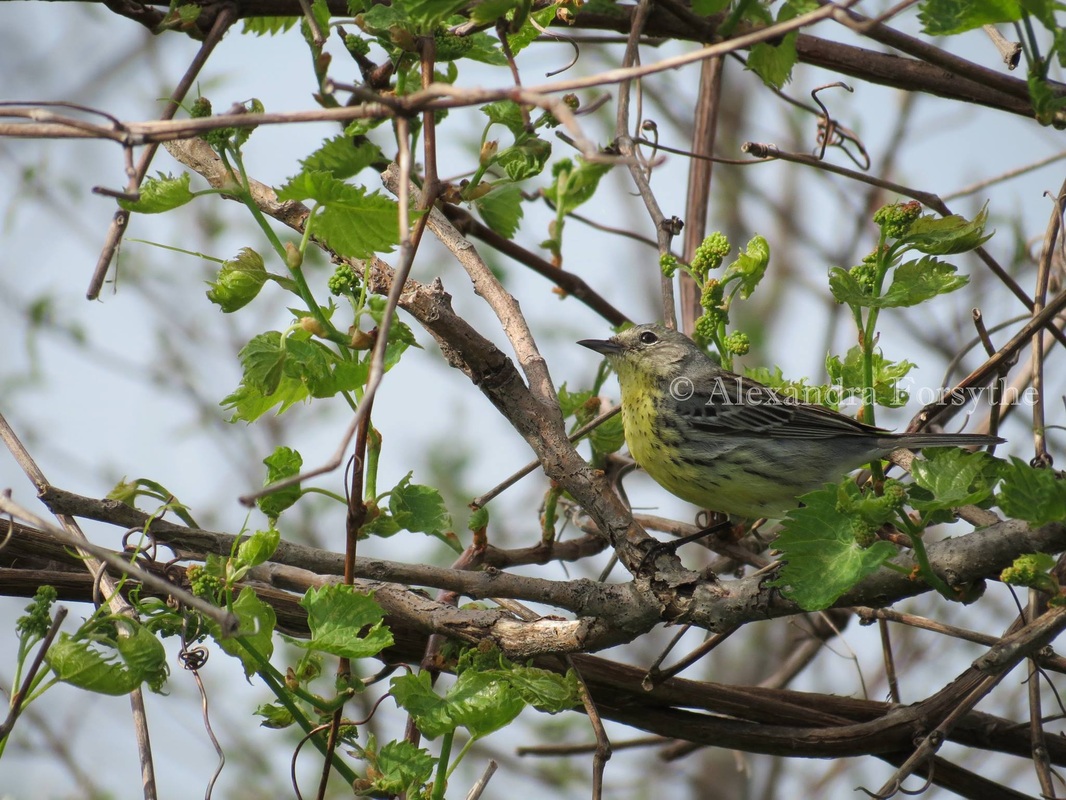
Kirtland's Warbler

4/1/2015

 
Want to start a stampede? Turn toward a crowd of birders and yell, “Kirtland’s Warbler!” 

The Kirtland’s is one of the most sought-after birds, especially in the springtime when a variety of warblers travel through Indiana, dressed in their most colorful finery, on the way to their breeding grounds. The Kirtland’s is not the most colorful of the warblers, nor is it one of most beautiful singers, but it is quite elusive, making it one of the most prized birds for listers.

The Kirtland’s Warbler’s story is one of conservation success. In 1970, they were heading toward extinction. Today, they are rebounding, but their ability to succeed rests largely in our hands. Fortunately, the Kirtland’s has captured the attention of brilliant scientists in the birding world and many studies are underway to determine the best methods of helping these birds continue to prosper.

Via email, I spoke with Dr. Nathan Cooper who is at the helm of one of the most comprehensive studies on the Kirtland’s. He and Pete Marra, director of the Smithsonian Migratory Bird Center, obtained funding to study the life history of the Kirtland’s Warblers using geolocators and radio-tracking devices. Dr. Cooper, his assistant Tom Ryan and volunteer David Bryden, are committed to spending time in the field, both in the breeding grounds and in the wintering grounds, to learn more about the birds’ movements, survival rates and habitat use.

The first step in the study was to place geolocators on adult birds. The geolocators monitor light levels and give the scientists an indication of the latitude and longitude of the birds. This allows them to track migration patterns and identify wintering locations. In all, 60 adult males were fitted with the devices. 

Next, the scientists wanted to place radio-tracking devices on 7-day old nestlings. Finding and watching the nests was challenging. Dr. Cooper explains: “If you get too close [the adults] fly away or become anxious and won’t visit the nest. And if you’re too far, you lose them in the dense vegetation.” The transmitters would help the scientists determine survival rates and the habitats used by the fledglings.

The news is both good and bad for the chicks. In his blog, Dr. Cooper notes: “Most of our nestlings survived long enough to make it out of the nest...Predation rates during the first few days out of the nest have been fairly high...Causes of death are somewhat unclear...It’s quite difficult to tell what type of animal killed a fledgling even with the carcass in hand.” I asked Dr. Cooper whether he had an educated guess regarding the number of Kirtland’s that are killed by cats. He didn’t have a specific estimate, but he sent me a paper that should be required reading for everyone: “The impact of free-ranging domestic cats on wildlife of the United States” by Loss, Will and Marra, 2012. The study found that domestic cats kill an astounding 1.4 - 3.7 billion birds in the United States every year!

The survival rates for Kirtland’s through their second year are more unclear. In response to my question, Dr. Cooper stated: “This is something we are still working on getting a good estimate for. In general it is a very difficult question to answer for most songbirds. More and more studies are investigating the post-fledgling period and finding that anywhere between 22 and 70% of birds survive until they gain independence from their parents. For Kirtland's it is looking like ~50% of fledglings survive this period, but the analyses aren't complete yet. Estimating survival after the post-fledgling period until the following breeding season is even more difficult for most species. However, recent estimates (“Using complementary approaches to estimate survival of juvenile and adult Eastern Kingbirds”, Redmond and Murphy 2012) suggest only about 20-30% of birds survive from leaving the nest until the next breeding season.”

Despite the challenges from Cowbirds, habitat loss and other obstacles, Kirtland's Warblers are making a comeback. When I asked about his prognosis for their long-term survival, Dr. Cooper was cautiously optimistic. “Kirtland's Warblers are a real success story for the Endangered Species Act. After reaching a low of only 200 males in the world, there are now over 2000 males. With continued management, I think the species has a very strong probability of long-term survival. One of the unknowns however, is how their wintering habitat will change as the Caribbean grows in population size, and as climate changes. This has driven us to want to better understand this period through the use of light-level geolocators to track birds throughout the annual cycle.”

The next stage of the study is underway. Dr. Cooper traveled to the Bahamas in early March to study the Kirtland’s in their wintering grounds. The team will travel to Cuba (another potential wintering grounds for the Kirtland’s) next year. His wish list for future studies includes a reevaluation of the Cowbird control program and the development of smaller GPS tracking devices suitable for Kirtland’s. “I am eager for this day to come because studying the same individuals on both the wintering and breeding grounds would be a dream come true.”

Be sure to follow the progress made by Dr. Cooper and his team here: http://www.nathanwcooper.com/news/. In the meantime, Dr. Cooper suggests that everyone support local and national conservation organizations like the Smithsonian Migratory Bird Center and Nature Conservancy. He also asks that we all help to protect migratory stopover habitats, and that we buy Smithsonian-certified bird-friendly coffee (http://nationalzoo.si.edu/scbi/migratorybirds/coffee/). He’s encouraged by the support he has found at the local level. “I'm always surprised by how many local people in the many areas I've worked truly care about birds and the environment. Many important issues often get lost at the national level, but when you talk to people who live in these wild areas, it's clear how much they care for and respect the land.”

Picture

Pied-billed Grebe

2/2/2015

 
Picture
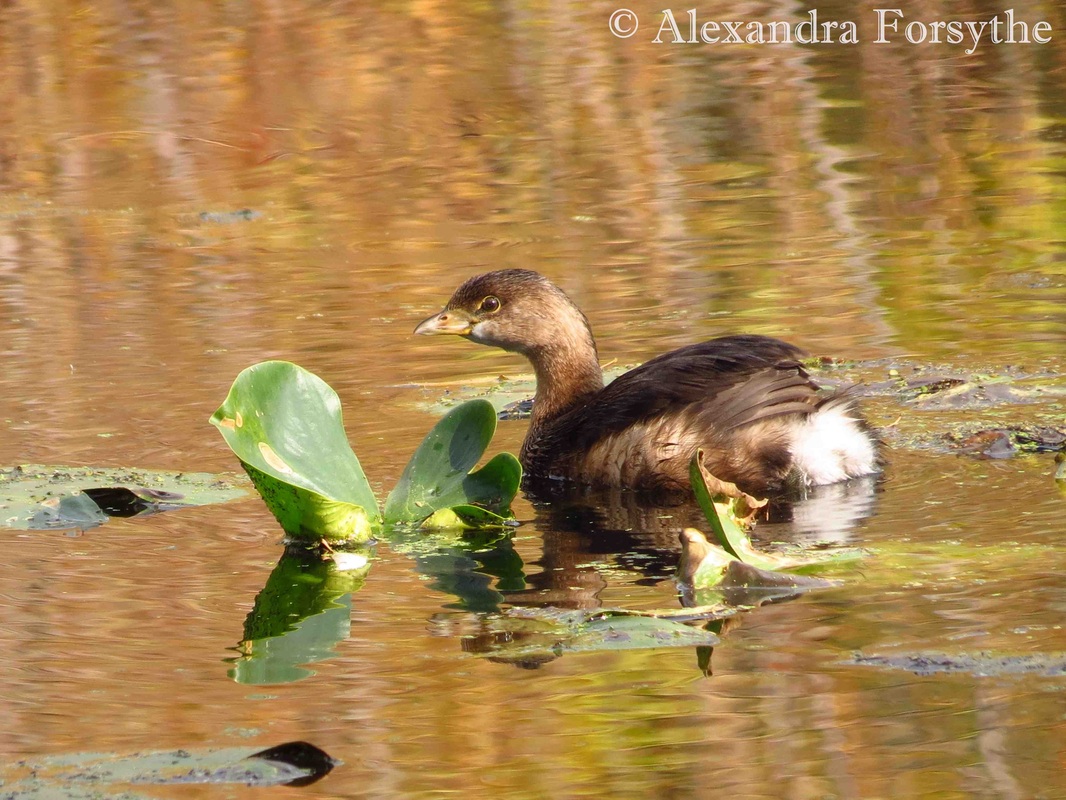
The Pied-billed Grebe: a small, chunky waterfowl that behaves like an alligator and has almost as many feathers inside its body as outside! Behaving like an alligator and dining on its own feathers are both means of protection. 

When startled, the Grebe often submerges, leaving only its eyes and nostrils above the surface of the water, watching the threat like a feathery, terrified alligator. Grebes can compress their feathers and squeeze out air, allowing them to submerge and remain at very specific depths for longer lengths of time. 

In addition to helping with submersion, the feathers also allow the grebes to devour prey that would otherwise be harmful. To protect its stomach and intestines from the bones of its prey, the Grebe will swallow its own feathers. The feathers mix with the indigestible portions of the prey and form a pellet that the grebe regurgitates, much like raptors do. It’s not unusual for over half of the Grebe’s stomach to be filled with feathers!

The grebe possesses other interesting adaptations, such as the placement of the legs and shape of the toes. Their legs are positioned further back than most birds, acting as ideal propellers. The shape of the toes adds to the effect; the toes are lobed, not webbed, strongly resembling the blades of a propeller.

The Pied-billed is one of over twenty species of grebes. Three of the species (Columbian, Atitlan and Alaotra) have gone extinct since the 1970’s, and five more are endangered (Junin, Hooded, New Zealand, Titicaca and Madagascar).  The Pied-billed populations declined somewhat from 1966 to 2010, but they are still widespread. 

These small waterfowl are easy to spot once you know what to look for. During breeding season, they’ll be easy to identify with their “pied” (black banded) bill. You can find them in large, quiet ponds or small, undisturbed lakes that have a lot of cattails, water lilies and other vegetation. 

The vegetation is also where you might spot a nest. If you see a circular mass of dead or dying vegetation, look closer. The Pied-billed prefers to build nests on floating plants that are rooted to the bottom of the pond or lake. Mud and additional vegetation are added to the nest throughout the season and keep the nest about 12 degrees Celsius warmer than the water. They are reclusive nesters, easily disturbed by humans. The wake from a canoe or kayak can create enough disturbance to destroy a nest or cause the eggs to fall into the water, so tread carefully! The chicks are colorful with rusty red, white and black stripes. When young, the chicks often ride on a parent’s back and may even accompany them on a dive!

I spotted this Pied-billed Grebe at Coffee Creek Park in Chesterton, Indiana. It was swimming quietly near the bank of a pond next to the road. It allowed me just enough time to take a photo before transforming into a submarine, diving into the depths and emerging on the far side of the pond some time later, almost disappearing in the vegetation. 

Christmas Bird Counts

1/10/2015

 
I participated in five Christmas Bird Counts (CBCs) this year, and it's something that I would highly recommend to young birders in particular. I had the chance to explore different habitats, see a variety of birds, work with many experienced birders and learn from each of them while thoroughly enjoying their company.

Since each CBC is held in a different area, it only makes sense that the birding will be different in each CBC. I find it even more interesting that each CBC has its own personality. Some are more relaxed, others are more like a sporting event and others are more like a family reunion.

The Pokagon CBC has been a tradition for decades and Mr. Fred Wooley runs it like a well-oiled machine. Everyone is familiar with their routes, and they know where each species of bird is likely to be found. We tend to stick with the same teams each year, so reconnecting with your team members is a happy reunion. Plus, Mr. Wooley always makes everyone feel welcome. It's a very warm, supportive atmosphere. Birding with Holly Meyers, Brad Bumgardner (sadly unavailable this year) and the Lothamers is guaranteed to be filled with laughter. What better way to end the year than by sharing some giggles with your birding friends! The habitats in and around Pokagon are fantastic for birding, and since I volunteer there, it always feels like home to me.

The Fort Wayne CBC has also been running for decades, but it was new to me. Mr. Jim Haw, one of the state's best birders, is in charge of it, and he does a fantastic job. His organizational skills are surpassed only by his phenomenal birding skills (by sight and by ear). I was happy to be placed with people I had never met - I love meeting new birders! This CBC is the most competitive of the five; there is a contest to determine which team saw the rarest bird. During the day, the teams are secretive about their bird lists, only disclosing their most interesting birds when all of the teams have returned for dinner. The contest adds a bit of sport and mystery, with team members playfully whispering and hiding their lists.

Tippecanoe's CBC in Kosciusko County has a more relaxed atmosphere. I was on Mr. Steve Doud's team, and since he is like a grandfather to me, I always have a great time birding with him. Plus, with a variety of apples from Doud Orchards in the car, it's the tastiest birding adventure one could hope for. Even though we took more time watching and studying each species than in the other CBCs, we saw the most species and the most individuals. Sometimes slow and steady does win the race!

The Limberlost (Adams County) CBC has a wonderful mixture of professionalism and warmth. Terri Gorney, the modern-day Gene Stratton-Porter, makes every volunteer feel like a member of the family. Every route is excellent, so each team is likely to see interesting birds. The various habitats attract everything from Short-eared Owls to Common Mergansers. This year the weather wasn't ideal, but everyone still found great birds and they were treated to the utmost in hospitality.

The SW Allen County CBC is brand new for this year, and it's the brilliant idea of Cynthia and Ed Powers. It covers many birding hot spots: Eagle Marsh, Fox Island and Arrowhead Prairie. Being part of a new CBC was exciting - checking out areas via Google Earth and scoping out the territories in advance. Unfortunately, on the morning of the CBC, freezing rain caused the start time to be delayed until noon and the ice forced many volunteers to stay at home. Cold rain throughout the day hindered our ability to see and hear many birds. Nevertheless, we met new people, explored new areas and saw some good birds. Cynthia and Ed have a good idea with this CBC, and Natalie Haley of Fox Island is always a fantastic host, so I hope this one is on the books for next year, too.

Every young birder should find at least one CBC in their area and volunteer. It's a fantastic way to learn more about birds and birding from some of the best birders in the area, explore new areas, see some great birds and have a wonderful time.

Picture

Snow Bunting

1/1/2015

 
Picture
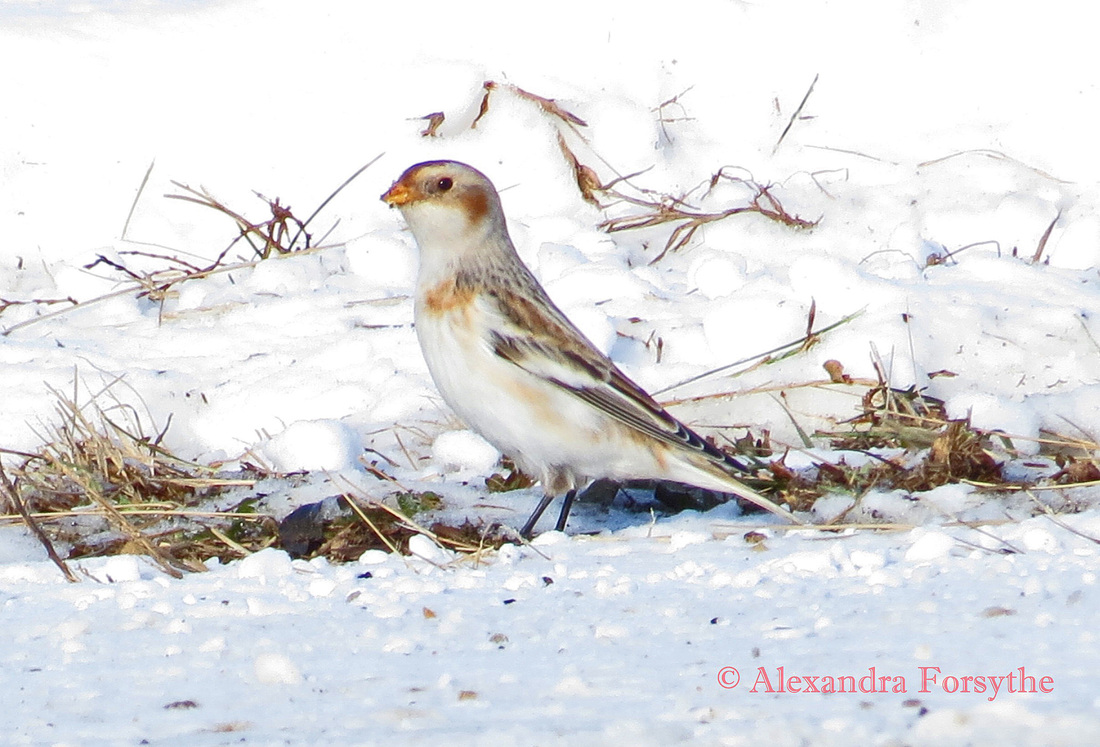
As I write this, it is 17 degrees Fahrenheit outside. The eggs that my chickens and ducks laid in their heated coops are near the freezing point. Can you imagine a songbird trying to incubate an egg in such frigid temperatures? Imagine no more! Meet the Snow Bunting! These tough birds will play and sing in temperatures of -22˚F, and they choose to raise their young above the Arctic Circle. Their cheerful song and demeanor despite such harsh conditions has earned the respect and admiration of generations of birders.

“In his far polar home,... the only sound that breaks the all-enveloping silence for months at a time, is the snow-bunting’s sweet vibrant song, happy and musical as the tinkle of the mountain brook. Along in August..., the snow-buntings don their warmer buff and brown plumage, and begin to assemble in considerable flocks on the grassier slopes for the journey southward. Quiet and still, as if sad to leave their northern home, they feed about the rocks, lingering even until November, when the night comes on, and the sun no longer shines even at noonday. Then the North is silent until they come again.” - The Wilson Bulletin (June 1919).

In winter, most birders look for the brightly-colored winter finches and elusive owls. However, there are several species of incredible birds that visit Indiana in winter that are often overlooked. The Snow Bunting is one of these winter birds. Its simple but elegant brown-and-white coloration makes it very difficult to spot in the snow-covered fields which they usually inhabit. 

Snow Buntings are typically found in Indiana in winter. They breed in the northernmost parts of Canada and Alaska - further north than any other songbird! They are also one of only four bird species that has been spotted near the north pole (the other three are Black-legged Kittiwake, Northern Fulmar and Arctic Tern). The males will migrate north to establish their territories long before the females migrate. The females do not migrate until four to six weeks later. When the males reach their breeding grounds, the nighttime temperatures will still dip below -22˚ Fahrenheit! To help keep the clutch warm, the nest is built in deep crevices within rocks and they line the nest with fur and feathers.

The Snow Bunting only has one molt per year. They molt in late summer at which time they get the brown-and-white coloring we are accustomed to seeing in winter. Their beautiful black and white breeding plumage is hidden underneath the brown coloring. To achieve his striking breeding plumage, the male Snow Bunting will scrape the brown feather tips off by rubbing them on the snow. By the time breeding season begins he will have his immaculate black-and-white coloring.

During last year’s Christmas Bird Count (2013-2014), 1,948 Snow Buntings were reported in Indiana, with the bulk of them (1,745) found in the Pokagon State Park vicinity. Snow Buntings were the sixth most plentiful bird in Canada’s Christmas Bird Count last year, with 101,541 individuals reported.

The cheery Snow Bunting has been loved by people for many years. Theodore Roosevelt wrote of the Snow Bunting:

“One bleak March day,...a flock of snow-buntings came...Every few moments one of them would mount into the air, hovering about with quivering wings and warbling a loud, merry song with some very sweet notes. They were a most welcome little group of guests, and we were sorry when, after loitering around a day or two, they disappeared toward their breeding haunts.”

To learn more about Snow Buntings, the banding and tracking efforts and other studies, check out the Canadian Snow Bunting Network on the web or Facebook via the Ruthven Park Bird Banding Station and Nature Blog.


Winter Wren

11/4/2014

 
Picture
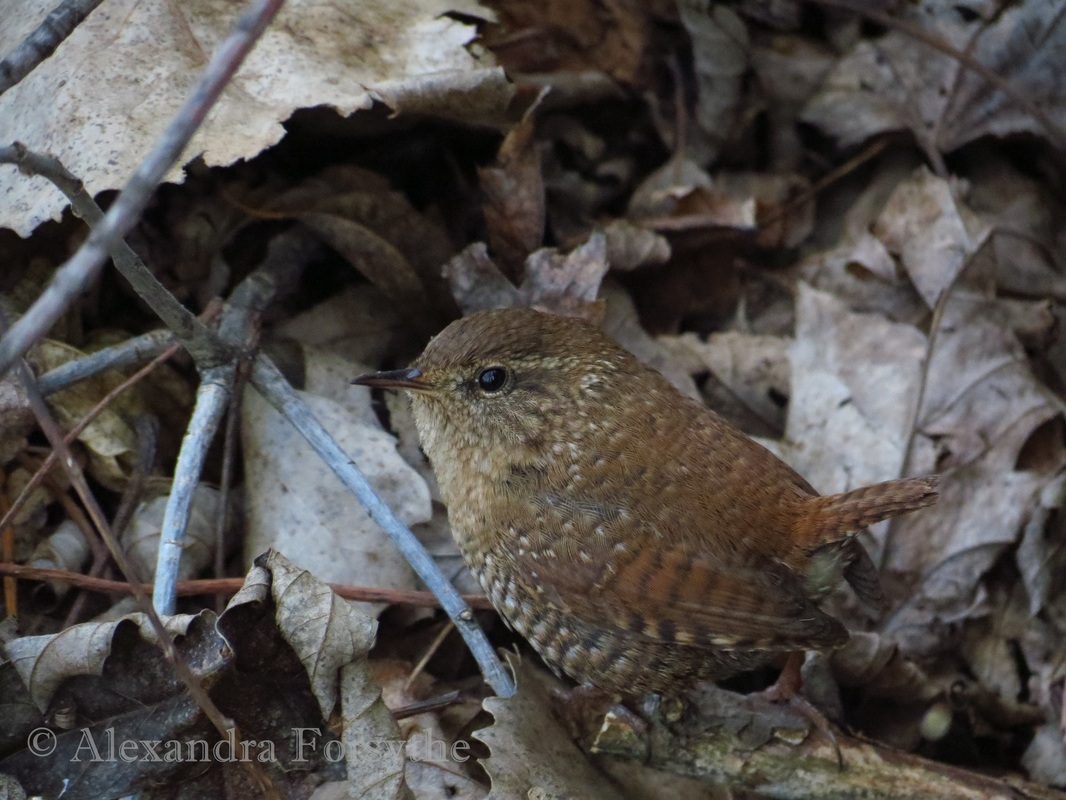
The tiny and adorable Winter Wren looks like a tiny brown ball of fluff with a very short tail that usually sticks straight up in the air. It is probably best known for what naturalist John Burroughs described as its “vibrating tongue of silver”. Its beautifully complex song is a cheerful mix with trills and twitters and it is quite high-pitched averaging around 5,500 hertz. There can be over 100 notes in a single Winter Wren’s 8-second song! Even when a recording of the song is slowed down it is hard to count all of the notes. Gram for gram, the Winter Wren sings more powerfully than a rooster; the wren uses ten times as much power to deliver its song than a rooster does! 

Winter Wrens, as their name suggests, will spend winter in Indiana and as far south as the Gulf Coast. They are often found near streams in brushy areas. The Winter Wren was split into three separate species in 2010: the Winter Wren and the Pacific Wren, both of which can be found commonly in North America, and the Eurasian Wren of the Old World. The Pacific Wren’s song is longer but not as musical as that of a Winter Wren. Where their ranges cross, male Winter and Pacific Wrens will fight over territory, but the females of each species will only choose mates from their own species. 

The uplifting song has the power to cheer us on a dreary winter’s day. Lynn Sprague said it best in “On Hearing a Winter Wren Sing in Winter”:

When wintry winds through woodlands blow
And naked tree-tops shake and shiver; 
While all the paths were bound in snow, 
And thick ice chains the merry river,

One little feathered denizen,
A plump and nut-brown winter wren,
Sings of spring-time even there 
—Tsip-twis-ch-e-e-e cheerily-cheerily-dare--
Who could listen and despair? 

Charmed with the sweetness of his strain. 
My heart found cheer in winters bluster; 
The leafless wood was fair again, 
Its ice-gems sparkled with new luster. 

The tiny, trembling, tinkling throat
Poured forth despairs sure antidote,
No leafy June hears sweeter note 
— Tsip-twis-ch-e-e-e cheerily-cheerily-dare --
The essence of unspoken prayer. 


Race 4 Birds Fundraiser

10/8/2014

1 Comment

 
Hi, I'm Alex Forsythe and I am 15 years old. I'm honored to serve on the youth board for R4B and I'm thrilled to be able to talk to you about my experience running an R4B event.

I am also a volunteer for Soarin' Hawk Raptor Rehab in Fort Wayne, Indiana. Soarin' Hawk helps injured and orphaned raptors return to the wild.  We also give presentations and classes to teach children and adults about birds of prey. All of us, even the veterinarian, are volunteers. I am the dispatcher for Soarin' Hawk, I conduct rescues, I give presentations, and I help with the birds that need intensive care or special physical therapy.

Immediately after the official launch of R4B, I approached the board of directors of Soarin Hawk Raptor Rehab about hosting and benefiting from an R4B fundraiser. They jumped at the idea without hesitation, and it's easy to see why. It appeals to just about every demographic!

Parents love it because it gets the kids out of the house, and away from their phones and video games.

Teachers love it because it encourages kids to do research, and identifying birds force s kids to fine tune their attention to detail. Those skills carry over into the classroom.

Kids love it. The athletes and competitive kids like the adrenalin rush while the quiet kids enjoy the planning, studying and listening required to be a top birder.

Sponsors love it because their advertising dollars build goodwill in the community while raising awareness about a cause or organization.

The board of Soarin Hawk recognized that R4B would have broad appeal, so we scheduled the event right away. We set our goals: 20 kids and we wanted to net $1,000.00. We exceeded both goals by 50%, but I'll tell you more about that later.

We chose a date during migration so we'd see a wider variety of birds. We also chose a starting point that was centrally located, is known to be great for birding, and is accessible to children of all abilities.

To advertise we used the social media outlets, flyers, and websites. We also sent out press releases to all of the local media. To find participants and sponsors, we contacted everyone we knew. We spoke with groups and we handed out flyers at schools, parks and businesses.

We arranged to have most of Soarin Hawk's education birds waiting at the finish line to greet the kids. We also had a buffet table set up with pizza donated by Pizza Hut and healthy snacks donated by Doud Orchards for the kids.

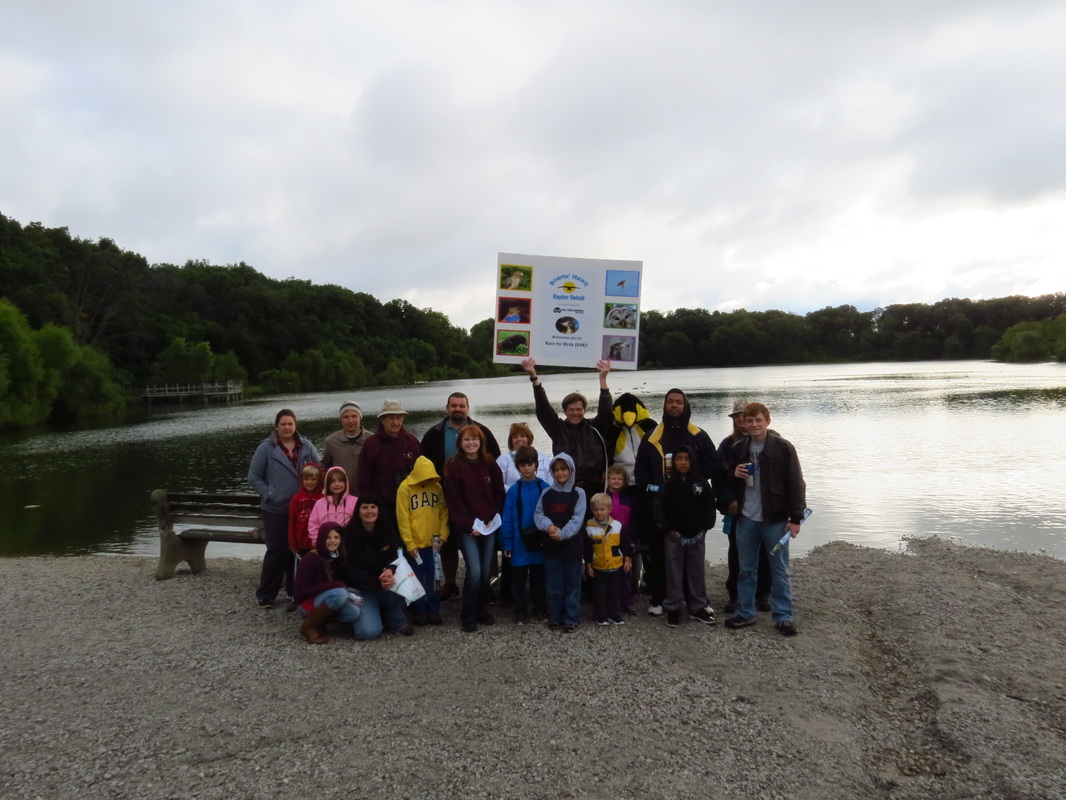
The finish line was inside a bird observation building so the kids could sit down and eat while watching even more birds. Meanwhile they could get their photos taken with our raptors - hawks, falcons, owls - and learn more about raptors and rehabilitation from the Soarin Hawk staff.

Twenty kids registered for the event, but on the day of the race we had about 50% more kids show up  than had registered - 28 children participated. A portion of the kids were unable to get to the starting line due to a road closure but they improvised and joined us as soon as they could.

I am proud to announce that we beat our goal of $1,000.00. We raised over $1,500.00 ! And that is net gain. Everything was donated - the banners, the prizes, the food, even the venue! So 100% of the money we raised will go toward the medical expenses and feeding of the birds of prey!

Soarin Hawk is so excited by the results, they want to have an R4B event every year! They would like to build a new facility, and the type of exposure R4B has brought them may help them achieve their goal so that more birds and audiences will benefit. 

Perhaps more importantly the event captured the attention of a lot of kids that had little or no interest in birds. Several of those kids are now interested in birding and becoming volunteers.

So the R4B event was a huge success on many levels.

From the beginning the board members and mentors at R4B were incredibly helpful. Any question I had was immediately answered, and the website contains everything you need to get started. The people connected with R4B are so well known and respected that the association with them was enough to gain the interest of anyone remotely familiar with birding. Our event was a  tremendous  success and we would not have been able to accomplish what we did without R4B's support.

Since I had the help of the R4B board and mentors, everything went better than expected. There are only a couple of things I would do differently. I would have the starting line and finish line be in the same location. We had them in two separate locations at the request of our sponsors. Two park systems wanted the exposure and rather than choose just one, we tried to please both of them. However having two locations caused some confusion.

I would also set a rain date. We were lucky because we had perfect weather. Next time we might not be as lucky.

I would highly recommend holding an R4B event. The level of help and expertise you have at your disposal from the website, board and mentors is unmatched. You'll increase your visibility in the community, especially among young people. You'll help children find a way to become involved with a good cause, or at least engage in an outdoor activity that will last their entire lifetime. In short, R4B will help you make a difference!

Picture
1 Comment
<<Previous
Forward>>

    Archives

    April 2021
    March 2021
    February 2021
    January 2021
    December 2020
    November 2020
    October 2020
    September 2020
    July 2016
    February 2016
    October 2015
    June 2015
    May 2015
    April 2015
    February 2015
    January 2015
    November 2014
    October 2014
    September 2014
    August 2014
    July 2014
    June 2014
    May 2014
    April 2014
    November 2013
    October 2013

Powered by Create your own unique website with customizable templates.